
Key takeaways
- Compare the best juicers, from fast centrifugal models to slow masticating presses, on yield, chute size, cleanup effort and leafy-green performance.
Disclosure: As an Amazon Associate, I earn from qualifying purchases.
A juicer is one of the easiest kitchen appliances to buy and one of the easiest to abandon. Whether a machine gets used every morning or ends up in a cupboard usually comes down to two things: how well it handles the produce you actually buy, and how painful it is to clean. This guide compares five well-regarded machines across the three main juicer types — centrifugal, masticating (slow), and citrus — so you can match the machine to your habits.
One honest note before the picks: juicing is not a health shortcut. Extracting juice removes most of the fiber from fruit and vegetables and concentrates their natural sugars into a small glass, so a large serving of fruit juice can carry a sugar load similar to soda. There is no credible evidence that juice “detoxes” or “cleanses” anything — your liver and kidneys do that — and anyone managing blood sugar, including people with diabetes, should treat juice as an occasional small serving rather than a daily staple, leaning toward vegetable-heavy recipes. Juice is a pleasant way to use up produce and add variety to your diet. It is not medicine.
How to Choose the Right Juicer
Start with the type. Centrifugal juicers spin a mesh basket at high speed, shredding produce against a cutting disc and flinging the juice out. They are fast and handle hard produce like apples, carrots, and beets very well. Their weakness is leafy greens and soft fruit: spinach and kale blow through the basket half-processed, yields are lower, and the spin whips air into the juice, so it oxidizes faster and is best drunk within about 24 hours. Masticating (slow) juicers use an auger turning at roughly 40 to 80 RPM to crush and press produce against a strainer. They extract noticeably more from leafy greens, wheatgrass, and soft produce, run quietly, and produce drier pulp; the trade-offs are slower operation, narrower chutes on many models, and more parts to wash. Citrus juicers are single-purpose reamers for oranges, lemons, limes, and grapefruit — cheap, tiny, and useless for anything else.
Check the feed chute against your patience. A wide 3-inch chute swallows whole apples and cuts prep to almost nothing. A narrow chute means chopping everything into strips first, which adds minutes to every session. Self-feeding hopper designs, like the Nama below, split the difference: load chopped produce into a chamber and the machine feeds itself.
Count the parts before you fall in love. Cleanup is the number one reason juicers get abandoned, and it scales with part count. A centrifugal machine might have five parts to rinse; a slow juicer can have eight or nine, including a fine strainer that needs scrubbing with a brush. Dishwasher-safe parts help, but almost every strainer still needs a hand scrub to keep the mesh from clogging. If you will not spend five minutes at the sink, pick the machine with the fewest pieces, not the highest yield.
Match capacity and footprint to your kitchen. Pulp containers range from a pint on compact machines to 2.5 liters on full-size centrifugals; small bins mean stopping mid-session to empty them when juicing for a family. Slow juicers are heavy and often tall, while centrifugal models are lighter but loud enough to wake a household — if you juice at 6 a.m., a quiet masticating machine is worth more than raw speed.
The 5 Best Juicers
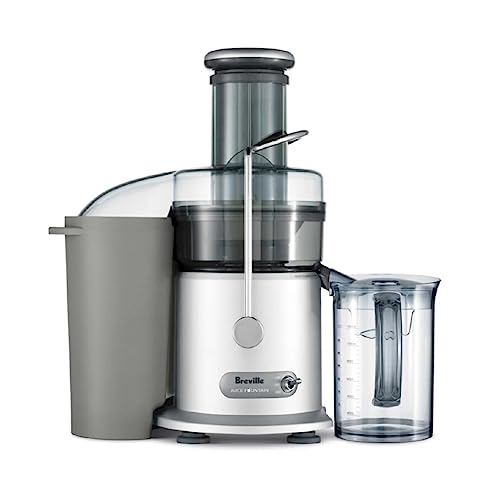
1. Breville Juice Fountain Plus JE98XL — Best Centrifugal for Most People
ASIN: B003R28HWQ
The Juice Fountain Plus remains the easiest recommendation for anyone who wants a glass of juice in under a minute. Its 3-inch chute takes whole apples, the two-speed control handles both hard roots and soft fruit, and the micro-mesh filter keeps most pulp out of the juice. It is loud and it will not love your kale, but for carrots, apples, and celery it is quick and consistent.
Specs:
– Type: Centrifugal
– Power: 850 watts, two speeds (low around 6,500 RPM, high around 12,000 RPM)
– Feed chute: 3 inches, fits whole apples
– Containers: 2.5 L pulp container; 1 L juice jug with froth separator
– Dishwasher-safe parts: Yes — removable parts are top-rack dishwasher safe per Breville (the filter basket still benefits from a soak and brush)
Pros:
– Extremely fast — a full jug in a couple of minutes
– Wide chute means almost no chopping
– Large pulp bin suits family-size batches
Cons:
– Poor yield from leafy greens and wheatgrass
– Loud at full speed
– Juice oxidizes quickly; best consumed the same day
Who it suits: Busy households juicing hard fruit and vegetables who value speed and easy cleanup over maximum yield.
2. Omega NC900HDC — Best Masticating Juicer for Greens and Versatility

ASIN: B00CIU92S6
The NC900HDC is a horizontal single-auger machine built around one job — squeezing — and it does it thoroughly. Its dual-stage extraction and five adjustable pressure settings let you tighten the end cap for hard produce or loosen it for soft fruit, and the same auger system doubles as a food processor, extruding pasta and making nut butter and sorbet with the included attachments. For leafy greens and wheatgrass, it extracts far more than any centrifugal in this guide.
Specs:
– Type: Masticating (horizontal single auger, dual-stage)
– Power/RPM: 150 watts, 80 RPM
– Feed chute: Small chute, about 1.5 inches — produce must be cut into strips
– Containers: Juice and pulp collection cups included (no large internal bin)
– Dishwasher-safe parts: Removable parts are not dishwasher rated per Omega; they rinse quickly and a cleaning brush is included
Pros:
– Excellent yield from leafy greens, celery, and wheatgrass
– Adjustable end cap fine-tunes pressure by produce type
– Attachments add pasta, nut butter, and sorbet functions
Cons:
– Slow — feeding and pressing takes several minutes per batch
– Narrow chute means real prep work
– Many small parts to rinse after each use
Who it suits: Dedicated juicers focused on green juices and wheatgrass, and anyone who will actually use the nutrition-center attachments.
3. Nama J2 — Best Self-Feeding Slow Juicer

ASIN: B0DSXYQY6S
The J2 solves the slow juicer’s biggest annoyance — standing at the chute feeding pieces one by one. Its large top hopper holds a whole recipe’s worth of chopped produce, and an internal blade cuts and feeds it to the auger automatically, so you can load it, walk away, and come back to finished juice. It produces high yields with dry pulp across greens, roots, and fruit, with fewer parts than most slow juicers.
Specs:
– Type: Masticating (vertical single auger, self-feeding hopper)
– Power/RPM: 200 watts, 50 RPM
– Feed chute: Wide loading hopper that holds a full batch of produce (load-and-go design)
– Containers: Juice container and pulp container included, roughly 30 fl oz juice capacity per batch
– Dishwasher-safe parts: No — Nama directs hand washing for the juicing parts
Pros:
– Hands-free operation — load the hopper and walk away
– High yield and dry pulp from greens and hard produce alike
– Fewer parts than most slow juicers; quick to reassemble
– Quiet running
Cons:
– Premium machine with a large countertop footprint
– Hand washing only
Who it suits: Daily juicers who batch-produce juice and want slow-juicer yield without standing over the machine feeding it piece by piece.
4. Hamilton Beach Big Mouth 67601A — Best Budget Centrifugal

ASIN: B00E0IBKLQ
The Big Mouth proves you do not need to spend much to get competent centrifugal juicing. Its 800-watt motor and 3-inch chute handle whole apples and carrots with ease, the extra-large pulp bin lets you make a big batch without stopping, and every removable part goes in the dishwasher. Juice quality is a step behind the Breville — slightly pulpier, slightly foamier — but for occasional juicing it covers the basics honestly.
Specs:
– Type: Centrifugal
– Power: 800 watts, single speed
– Feed chute: 3 inches, fits whole fruits and vegetables
– Containers: Extra-large pulp bin (roughly 20 oz juice per continuous session before emptying is typical); juice cup not included
– Dishwasher-safe parts: Yes — all removable parts are dishwasher safe per Hamilton Beach
Pros:
– Wide chute and strong motor for the class
– Dishwasher-safe parts make cleanup genuinely easy
– Large pulp bin for uninterrupted batches
– Compact enough for smaller counters
Cons:
– Single speed is a compromise for soft fruit
– Wetter pulp than the Breville — lower yield
Who it suits: Beginners and occasional juicers who want to find out whether juicing fits their routine before committing to a premium machine.
5. Cuisinart Pulp Control Citrus Juicer CCJ-500P1 — Best for Citrus Only

ASIN: B004VS32HA
If your juicing life is orange juice at breakfast and lemons for cooking, a dedicated citrus juicer beats a full-size machine on size and cleanup. The CCJ-500P1’s universal cone fits everything from limes to grapefruit, auto-reverses to work the fruit from both directions, and offers three pulp settings so you choose how much body stays in the juice. It juices straight into your glass, so there is little to wash beyond the cone and strainer.
Specs:
– Type: Citrus (electric reamer)
– Power: Low-power motor (25 watts maximum per the manual) with auto-reversing cone
– Feed chute: Not applicable — universal reamer cone fits limes through grapefruit
– Containers: None — snap-up spout dispenses directly into a glass
– Dishwasher-safe parts: Yes — removable parts are dishwasher safe per Cuisinart
Pros:
– Three pulp control settings (low, medium, high)
– Final-Spin extracts extra juice from the pulp
– Tiny footprint; stores almost anywhere
Cons:
– Citrus fruit only — no vegetables, greens, or other fruit
– Small batches; juicing for a crowd takes a while
– Not suited to anyone wanting green or mixed juices
Who it suits: Households that drink citrus juice regularly and want a small, simple appliance instead of a full juicing setup.
Comparison Table
| Model | Type | Power / RPM | Feed Chute | Dishwasher-Safe Parts | Best For |
|---|---|---|---|---|---|
| Breville Juice Fountain Plus JE98XL | Centrifugal | 850 W / up to 12,000 RPM | 3 in | Yes (top rack) | Fast everyday juicing |
| Omega NC900HDC | Masticating | 150 W / 80 RPM | ~1.5 in | No | Greens, wheatgrass, versatility |
| Nama J2 | Masticating, self-feeding | 200 W / 50 RPM | Batch hopper | No | Hands-free batch juicing |
| Hamilton Beach Big Mouth 67601A | Centrifugal | 800 W / single speed | 3 in | Yes | Budget-friendly starting point |
| Cuisinart CCJ-500P1 | Citrus | 25 W / auto-reversing cone | N/A (reamer) | Yes | Oranges, lemons, grapefruit |
FAQ
Is slow juicer juice actually more nutritious than centrifugal juice?
The difference is smaller than marketing suggests. Slow juicers usually extract more juice from the same produce — especially greens — and less air is whipped in, which slows oxidation. But the vitamin gap between the two methods is modest. The real differences are yield and shelf life, not nutrition.
How long does fresh juice keep in the fridge?
Centrifugal juice is best within 24 hours because the spinning process incorporates air that speeds oxidation. Slow-pressed juice generally holds up for up to 72 hours in a sealed container in the fridge. Either way, fill the container to the brim to limit air exposure, refrigerate immediately, and discard juice that smells off or tastes fizzy.
Can I juice leafy greens in a centrifugal juicer?
You can, but expect disappointing results. Loose leaves tend to pass through the basket barely processed. A common workaround is to roll greens into tight bundles or sandwich them between hard items like apple chunks, which helps somewhat. If green juice is your main goal, a masticating machine like the Omega or Nama is the right tool rather than a workaround.
Does juicing help with weight loss or detoxing?
No juicer detoxes anything — that is your liver and kidneys’ job, and juice cleanses have no proven benefit there. For weight, juice is a mixed bag: it removes the fiber that makes whole produce filling while keeping most of the sugar, so it is easy to drink the calories of four oranges without feeling full. Vegetable-heavy juices with a little fruit fit far more sensibly into a balanced diet.
Conclusion
Match the machine to your produce and your patience. The Breville Juice Fountain Plus is the best all-round centrifugal for fast, low-fuss juicing of hard produce. The Omega NC900HDC is the pick for green-juice devotees who will use its extra attachments. The Nama J2 earns its place for batch juicers who want slow-press yield without the feeding ritual. The Hamilton Beach Big Mouth is the sensible first juicer, and the Cuisinart CCJ-500P1 is all a citrus household needs. Whichever you choose, buy the machine whose cleaning routine you will tolerate — the best juicer is the one still on your counter in six months.
More from Amazon
Programs that pair well with the guide above. Offers and eligibility are set by Amazon and may change.
Free shipping on eligible items, Prime Video and more. Eligible new members can start with a free trial.
Start a Prime free trialAudiobooks and podcasts to listen to on the go. Eligible new members can start with a free trial.
Try Audible freeAd-free music streaming. Eligible new subscribers can start with a free trial.
Try Music Unlimited freeA free business account with business pricing and bulk-buying tools for work, shop or home office.
Create a business accountAs an Amazon Associate we earn from qualifying purchases.




Write Your Review
No reviews yet. Be the first to share your experience!