
Our Short List of 3
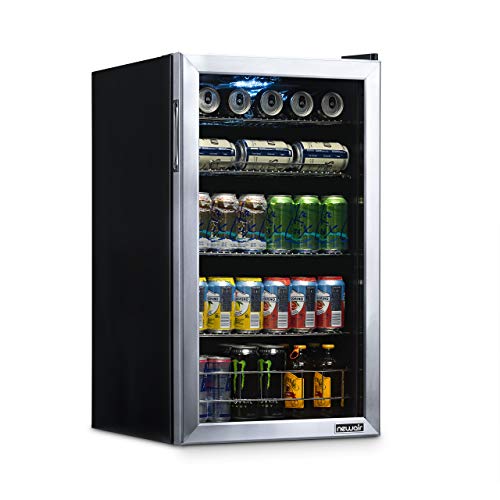
- Best for: households that buy drinks in bulk and need the largest can count.
- Capacity: 3.4 cubic feet; holds up to 126 cans
- Model: NBC126SS02
- Cooling: compressor cooling; cools down to 37 degrees Fahrenheit
- Temperature control: 7 thermostat settings

- Best for: households that open the cooler often and want even cooling on every shelf.
- Capacity: 3.1 cubic feet; holds up to 127 standard cans per the listing
- Model: BR-130SB
- Cooling: compressor cooling with internal fan-forced circulation
- Temperature range: high 30s to mid 60s degrees Fahrenheit

- Best for: shared households that want a lockable cooler from a long-established brand.
- Capacity: 3.1 cubic feet; holds up to 117 cans
- Model: DBC117A1BSSDB-6
- Cooling: fan-forced cooling
- Temperature range: 35.6 to 50 degrees Fahrenheit
All 4 Picks at a Glance
| Product | Specs | Action |
|---|---|---|
| NewAir 126-Can Beverage Refrigerator NBC126SS02 |
| Check price on Amazon |
| Whynter 127-Can Beverage Refrigerator BR-130SB |
| Check price on Amazon |
| Danby 117-Can Beverage Center DBC117A1BSSDB-6 |
| Check price on Amazon |
 EUHOMY 128-Can Beverage Refrigerator BR-110 |
| Check price on Amazon |
Key takeaways
- Compare five freestanding beverage coolers for secondary kitchen storage, with glass doors, can capacity, shelving, and temperature control compared.
A second fridge sounds simple until you try to fit one into a working kitchen. The real decision is not whether you need more cold drink storage, but which freestanding cooler earns its floor space: one tall enough to hold a full shop of cans and bottles, narrow enough to slide beside a counter or pantry wall, and cold enough that drinks come out properly chilled on a hot afternoon. Get the size or the temperature range wrong and the cooler becomes an expensive cupboard.
This guide is for households whose main refrigerator is crowded with food while cans and bottles pile up on counters and in shopping bags. It also suits anyone setting up a drinks station near a dining table or home bar without cutting into cabinets. Every cooler below was chosen from the product names and specifications shown on its Amazon page, so you can compare capacity, shelving, and temperature control on the same terms the seller publishes.
Quick Picks
As an Amazon Associate we earn from qualifying purchases
| Product | Best for | Key spec |
|---|---|---|
| NewAir 126-Can Beverage Refrigerator | Stocking a full household drink supply | 126 cans, 3.4 cubic feet |
| hOmeLabs 120-Can Beverage Refrigerator | A tidy second cooler beside the main kitchen | 120 cans, 3.2 cubic feet |
| Whynter 127-Can Beverage Refrigerator | Even cooling across every shelf | 127 cans, fan-forced compressor cooling |
| Danby 117-Can Beverage Center | A lockable cooler in a shared household | 117 cans, keyed door lock |
| EUHOMY 128-Can Beverage Refrigerator | The largest can count in a compact footprint | 128 cans, digital temperature control |
How to Choose
Measure the spot before you shop
Freestanding coolers need breathing room, so measure width, depth, and height of the spot plus the door swing before ordering. Most models in this guide are around 17 to 19 inches wide and 31 to 34 inches tall, but handles and hinges add depth that a tape measure can miss. Leave a few inches of clearance on the sides and back so warm air can escape, and check that the door can open fully without hitting a wall, a drawer, or the main refrigerator. A cooler that fits on paper but cannot open properly will frustrate you every day.
Match capacity to how you actually stock drinks
Can counts are measured with standard cans packed tightly, so treat them as a maximum rather than a promise. A household that buys a few multipacks a week will be comfortable with around 117 to 120 cans, while a family that stocks up for gatherings or keeps several drink types on hand should look toward 126 cans or more. Bottles take more room than cans, especially tall ones, so count how many bottles you usually keep cold. Adjustable shelves matter here, because removing or moving one shelf can make room for taller bottles without wasting the whole cabinet.
Check the temperature range and controls
Drinks taste best cold, but different drinks have different sweet spots, so the temperature range matters more than a single low number. Look for a cooler that reaches the high 30s in Fahrenheit for sodas and lagers, with a top end in the 50s or low 60s if you also store drinks that should not be ice cold. Digital controls make it easier to set and check the temperature, while a simple dial works fine if you rarely change it. Whichever style you choose, confirm the range on the product page rather than assuming every beverage cooler gets equally cold.
Look at shelves, door, and ventilation
Shelving decides how useful the inside really is. Slide-out wire shelves let you pull cans forward instead of reaching past the front row, and removable shelves let you trade a shelf for tall bottles. A glass door is the point of a beverage cooler: it shows the stock at a glance and stops the door opening every time someone checks what is cold. Check whether the door is reversible, so the hinge can sit on the side that suits your room, and whether it locks if children or guests share the space. Finally, remember these models vent warm air at the back and sides, so they belong in open floor space, not sealed inside a cabinet.
The 5 Best Options
NewAir 126-Can Beverage Refrigerator NBC126SS02
- Best for: households that buy drinks in bulk and need the largest can count.
- Capacity: 3.4 cubic feet; holds up to 126 cans
- Model: NBC126SS02
- Cooling: compressor cooling; cools down to 37 degrees Fahrenheit
- Temperature control: 7 thermostat settings
households that buy drinks in bulk and need the largest can count.
measure the depth with the door closed, since the cabinet is deeper than many 17-inch-wide models.
The NewAir NBC126SS02 is the largest-capacity cooler in this guide, holding 126 cans in a 3.4 cubic foot cabinet that still fits a standard kitchen gap. Its stainless steel trimmed glass door shows the stock without opening it, and the compressor cooling system holds temperatures down to 37 degrees Fahrenheit across seven thermostat settings. Adjustable shelves let you mix cans and bottles, so a household that buys in bulk can keep several drink types cold at once. It is a straightforward choice when the second cooler must carry the whole household drink supply.
hOmeLabs 120-Can Beverage Refrigerator HME030065N
The hOmeLabs HME030065N is a tidy 120-can cooler that suits a secondary kitchen spot without dominating the room. Its 3.2 cubic foot cabinet has a glass door framed in stainless steel, so drinks stay visible, and three adjustable, removable shelves let you rearrange the inside for tall bottles or stacked cans. Compressor cooling keeps the temperature steady, and the digital thermostat gives a clear readout when you change settings. It fits households that want a dependable second cooler for everyday drinks rather than a showpiece for entertaining.
Specs
- Capacity: 3.2 cubic feet; holds up to 120 cans
- Model: HME030065N
- Cooling: compressor cooling
- Temperature range: 34 to 50 degrees Fahrenheit
- Door: glass door with stainless steel frame
- Shelves: 3 adjustable, removable shelves
- Installation type: freestanding
Best for: everyday family drinks kept beside the main kitchen.
Watch out for: the top temperature of 50 degrees Fahrenheit is warmer than some coolers in this guide, so check it suits drinks you prefer ice cold.
ASIN: B0786TJC33
Whynter 127-Can Beverage Refrigerator BR-130SB
- Best for: households that open the cooler often and want even cooling on every shelf.
- Capacity: 3.1 cubic feet; holds up to 127 standard cans per the listing
- Model: BR-130SB
- Cooling: compressor cooling with internal fan-forced circulation
- Temperature range: high 30s to mid 60s degrees Fahrenheit
households that open the cooler often and want even cooling on every shelf.
the maker manual rates the same model at 120 cans, so treat the 127-can figure as a tightly packed maximum.
The Whynter BR-130SB pairs a 3.1 cubic foot cabinet with fan-forced compressor cooling, so cold air circulates instead of settling at the bottom. The listing rates it at 127 standard cans, and five slide-out wire shelves make it easy to reach drinks at the back without unloading the front. A double-pane glass door with stainless steel trim keeps the contents visible while insulating better than a single pane, and the temperature runs from the high 30s to the mid 60s in Fahrenheit. It suits buyers who open the cooler often and want every shelf to stay evenly cold.
Danby 117-Can Beverage Center DBC117A1BSSDB-6
- Best for: shared households that want a lockable cooler from a long-established brand.
- Capacity: 3.1 cubic feet; holds up to 117 cans
- Model: DBC117A1BSSDB-6
- Cooling: fan-forced cooling
- Temperature range: 35.6 to 50 degrees Fahrenheit
shared households that want a lockable cooler from a long-established brand.
the mechanical thermostat uses a dial rather than a digital display, so allow time to settle on the setting you want.
The Danby DBC117A1BSSDB-6 is the name-brand pick in this guide, from a maker with long experience in compact refrigeration. Its 3.1 cubic foot cabinet holds 117 cans behind a tempered glass door with stainless steel trim, and a keyed lock keeps the contents secure in a shared household. Fan-forced cooling holds a steady temperature between 35.6 and 50 degrees Fahrenheit on a mechanical thermostat, and blue LED lighting shows the stock clearly. Three adjustable wire shelves let you fit bottles alongside cans without wasting space.
EUHOMY 128-Can Beverage Refrigerator BR-110
- Best for: tight floor space that still needs the largest can count in this guide.
- Capacity: 3.1 cubic feet; holds up to 128 cans
- Model: BR-110
- Cooling: compressor cooling with internal air-cooled system
- Temperature range: 32 to 61 degrees Fahrenheit
tight floor space that still needs the largest can count in this guide.
some listing text describes the capacity as 126 cans, so count on the lower figure when planning a big stock-up.
The EUHOMY BR-110 packs the largest can count in this guide into a compact 3.1 cubic foot cabinet, holding up to 128 cans behind a glass door. Four removable shelves let you switch between stacked cans and upright bottles, and the digital display sets the temperature from 32 to 61 degrees Fahrenheit, the widest range here. A quiet compressor with an internal air-cooled system keeps the cabinet even, while the reversible door and adjustable feet help it fit awkward corners. It is a strong pick when floor space is tight but the drink stock is large.
Which One Fits Your Situation
Your main fridge is always full of drinks
When food fills the main refrigerator and cans end up on the counter, a second cooler takes the drinks out of the way. The NewAir NBC126SS02 fits here because its 126-can capacity swallows a full weekly shop, so the main fridge keeps its shelves for food. Place it beside the pantry or dining area, load it once after shopping, and the family stops hunting through a crowded fridge for a cold can.
You host often and need a visible drink station
Hosting works better when guests can see the drinks without opening every door in the kitchen. The Whynter BR-130SB suits this spot because its double-pane glass door and five slide-out shelves put the whole stock on display, and fan-forced cooling keeps the back rows as cold as the front. Set it near the dining table, keep the shelves arranged by drink type, and guests help themselves without crowding the cook.
You share a kitchen and want drinks kept separate
In a shared house, a drinks cooler can end arguments about fridge space and borrowed cans. The Danby DBC117A1BSSDB-6 fits because its keyed door lock keeps your stock separate, and its 117-can capacity is generous without taking over the room. Agree on a spot near the dining area, keep the key somewhere sensible, and everyone knows which cold drinks are theirs.
You have a narrow gap beside a counter or pantry
A narrow gap calls for a cooler that is compact outside but roomy inside. The EUHOMY BR-110 fits because it holds up to 128 cans in a 3.1 cubic foot cabinet that measures 17.5 inches wide, and its reversible door opens from the side that suits the room. Check the gap width and the door swing first, leave clearance at the back, and a space that once held shopping bags becomes a proper drinks station.
Common Mistakes
- Buying a built-in model for an open floor spot, or pushing a freestanding cooler tight into a cabinet cutout where it cannot vent warm air.
- Trusting the can count as a promise, then finding tall bottles do not fit because no shelf was left adjustable.
- Skipping the tape measure and discovering the door hits a wall or a drawer before it opens fully.
- Choosing a cooler that cannot get cold enough for the drinks you like best, especially sodas and lagers that need the high 30s in Fahrenheit.
- Filling the cooler to the top on day one and blocking airflow, so drinks at the back stay warmer than the ones at the front.
Frequently Asked Questions
How many cans should a secondary kitchen cooler hold?
Most households do well with 117 to 128 cans, which covers a weekly shop plus a few extra multipacks for guests. Smaller households that buy drinks a few times a week can manage with less, but a larger cabinet is more forgiving when you stock up. Count bottles separately, since tall bottles take more room than standard cans and reduce the total.
Can a freestanding beverage cooler go under a counter?
No, not unless the product page says it is built for that use. Freestanding coolers vent warm air from the sides and back, so they need open clearance around the cabinet to cool properly. Sliding one into a tight under-counter gap can overheat the compressor and shorten its life. Keep it in open floor space with a few inches of clearance on every side.
Do glass-door beverage coolers keep drinks as cold as a main fridge?
Yes, when the cooler is sized and placed correctly. The models in this guide use compressor cooling and reach the high 30s in Fahrenheit, which is cold enough for sodas, water, and lagers. A double-pane glass door insulates better than a single pane, and keeping the door closed between uses helps the temperature stay steady.
How long should I wait before loading a new beverage cooler?
Let the cooler stand upright for a day before switching it on, then run it empty until it reaches your chosen temperature. This lets the coolant settle after delivery and gives the compressor a stable start. Loading warm drinks straight away forces the cooler to work harder and slows cooling, so chill the first load gradually instead.
FAQ
How many cans should a secondary kitchen cooler hold?
Can a freestanding beverage cooler go under a counter?
Do glass-door beverage coolers keep drinks as cold as a main fridge?
How long should I wait before loading a new beverage cooler?
More from Amazon
Programs that pair well with the guide above. Offers and eligibility are set by Amazon and may change.
Free shipping on eligible items, Prime Video and more. Eligible new members can start with a free trial.
Start a Prime free trialAudiobooks and podcasts to listen to on the go. Eligible new members can start with a free trial.
Try Audible freeAd-free music streaming. Eligible new subscribers can start with a free trial.
Try Music Unlimited freeA free business account with business pricing and bulk-buying tools for work, shop or home office.
Create a business accountAs an Amazon Associate we earn from qualifying purchases.
Write Your Review
No reviews yet. Be the first to share your experience!